Alumni Impact
Sweet returns
Alumni transform learning
By Alexandra Richter


When Ann Boyd, MBA ’97, returned to a classroom in the School of Management, she knew how to capture the students’ attention: bring dessert samples.

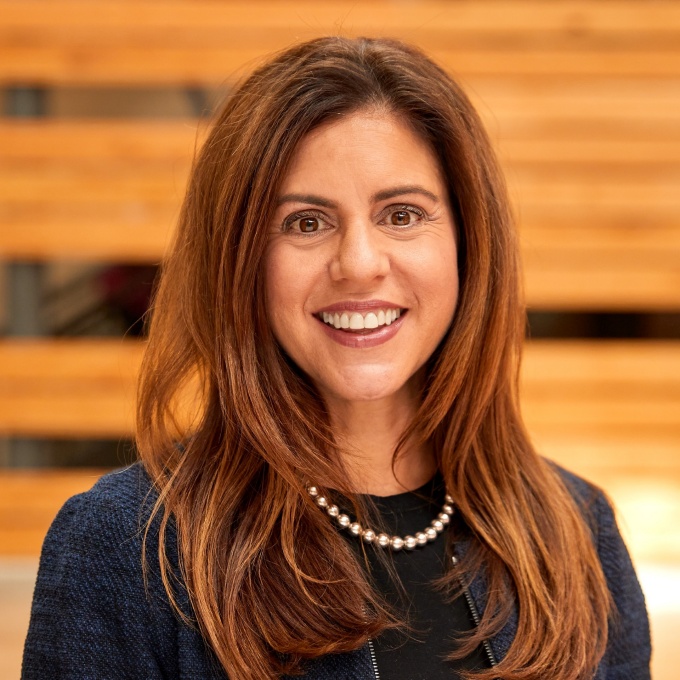
Boyd
As director of the Desserts business unit at Rich Products, Boyd was invited by M. Kim Saxton, clinical professor of marketing, to speak on product positioning to more than 450 undergraduates across two semesters of Principles of Marketing.
“Students can learn about product positioning in a textbook, but to think about it in the context of real product examples right in front of them — and hear how it is used to execute strategy and its role in driving results by graduates who were once in their shoes — really brings concepts to life,” says Boyd.
During her presentations, Boyd shared insights from her own career journey while emphasizing the importance of clearly defining what makes a product stand out from competitors and shaping how consumers think about and connect with a brand.
“Exposing students to tangible examples of what they are learning in the classroom enables them to engage and relate in a meaningful way,” she says. “This helps students stand out in interviews and prepares them for greater success in their first roles after graduation.”
Across the School of Management, alumni are increasingly returning as co-educators, mentors and industry collaborators, helping students connect coursework to modern business practice.
Creating customized content


Storch
Adam Storch, BS ’02, is associate director at the U.S. Securities and Exchange Commission, where he founded the Event and Emerging Risk Examination Team and helped establish the SEC’s AI Task Force, on which he continues to serve. He also chairs the school’s Accounting Advisory Council’s Curriculum Committee, and has witnessed how business education is evolving alongside emerging technologies and wanted to create a unique experience for students.
“I’ve used emerging technologies to create custom educational materials for my son, Lucas, to firm up his understanding of sixth-grade concepts,” he says. “That made me wonder how I could apply the same approach with graduate students.”
Working with Brandon Szerwo, associate professor of accounting and law, Storch developed a fictitious company and built a case study around it. Using AI as a collaborative force, he generated the company’s filings, marketing materials, policies and procedures, executive bios and other internal documents, giving students realistic material to review for potential risks, inconsistencies and red flags that merit follow up.
“We wanted the content to feel relevant and bespoke to students,” Storch says. “It gave them the opportunity to do a mock audit and demonstrate their ability to exercise professional skepticism.”
Student presentations also sparked conversations about the growing role of AI in accounting.
“One of the risks we built into the case was a company exaggerating its level of sophistication with AI,” he says. “There’s buzz about AI being a threat to accountants, but it also creates real opportunities for auditors and assurance professionals to be increasingly relevant in a fast-developing space.”
For Storch, giving back is rooted in the example set by the faculty members who shaped his own experience, especially Alex Ampadu, clinical associate professor emeritus.
“Professor Ampadu gave so much to us,” he says. “I try to give back in a way that reflects his example.”
Industry feedback, Bills Mafia style
When Cecily Rodriguez, adjunct professor of organization and human resources, wanted the students in her Talent Management course to experience the kind of feedback and evaluation they might encounter in the workplace, she turned to alumni to bring that experience to her classroom.

Joe Ray (far left) with students and judges, including beloved superfan “Bobby Buffalo” (front row, center) from Cecily Rodriguez’s Talent Management course.
For a course project focused on developing strategies for the Buffalo Bills, Rodriguez invited alumni, industry professionals and dedicated Bills fans to serve as judges for student presentations. Among those who volunteered was Joe Ray, BS ’14, director of marketing at Lighthouse Technology Services.
Ray evaluated presentations and provided professional feedback on both students’ ideas and delivery, helping them refine their presentation skills.
“I was impressed by how the students received feedback,” Ray says. “They genuinely wanted to know what they could do better and what we liked best, so they could build on it.”
What stood out even more to Ray was the students’ level of preparation and engagement.
“In a Wednesday early morning class toward the end of the semester, the students were on their game,” he says.
Improving financial literacy
For Stanley J. Kon, PhD ’76, returning to the classroom combined decades of academic research and industry experience to help students better understand the integration and tradeoffs in financial planning and wealth portfolio management from the perspective of a unique family of preferences. Kon is co-teaching a new course with Michael Brace and Jennifer Wu, both clinical assistant professors of finance.

Kon speaks with students in the finance course he co-teaches. Photo: Tom Wolf
“I began teaching again because I wanted to improve financial literacy,” Kon says. “Our goal is to help students understand that there is no one-size-fits-all approach to financial planning and wealth management, with a focus on lifetime, holistic decision-making. We want students to think critically about the downside risks of various investment strategies relative to their goals.”
The class draws on lessons from a forthcoming book coauthored by Kon — Dynamic Lifetime Financial Decisions: A Framework for Managing Wealth Under Uncertainty, Constraint, and Change. Students also work through assignments using WealthFluent, a personalized decision-making platform Kon co-founded.
During the semester, Kon traveled from his home in Colorado to spend time with the students on campus in Buffalo.
“Teaching is best as a one-on-one activity. I want to be face-to-face with students,” he says. “My time at UB was the most productive three years of my life because it was enriched by thoughtful debates with faculty and classmates. I want students to leave with the same sense of curiosity that shapes a lifelong career.”
By returning to the classroom, Kon and other alumni are sharing knowledge while strengthening the connection between students and graduates.
“Our student surveys consistently show that opportunities to engage with alumni and the business community are the first predictor of student satisfaction and learning,” says Cynthia Shore, senior assistant dean for alumni and external engagement. “Hearing directly from those in the workplace helps students better understand how classroom concepts translate into real-world decision-making."