Leveraging management skills for biomedical research

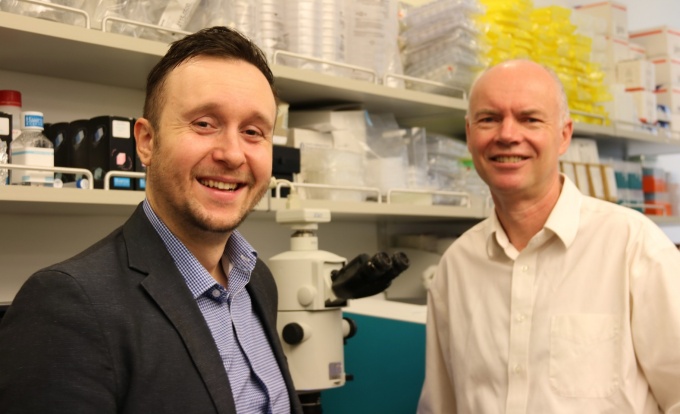
Dominic Sellitto and Edward Snell in a lab at the UB Hauptman-Woodward Research Institute.
When Dominic Sellitto asks his management students, “What if we could use artificial intelligence to better understand how radiation affects human health and help cure disease?” he is encouraging them to think boldly and apply management principles in new and meaningful ways.
Sellitto’s new mindset is thanks to a $1.5 million, three-year grant awarded by the Department of Energy for AI-assisted biomedical research. The project, a collaboration between the UB Hauptman-Woodward Medical Research Institute and the School of Management, is changing how students see the role of management.
“Our research allows students to envision alternate career paths by taking what management is really good at — operationalizing, applying and solving problems for business — and bringing it to scientific research,” says Sellitto, clinical associate professor of management science and systems. “It is the same as what we would do for any other business we consult for: build a product or solution.”
The idea for the collaboration began during a conversation between Sellitto and Edward Snell, chief scientific officer at UB-HWI, in 2023. Their project combines UB-HWI’s expertise in structural biology with the School of Management’s strength in applied problem-solving to use AI to study how cells and molecules respond to low doses of radiation.
The project is part of the Low Dose Radiation Research program, which supports research to develop disease risk prediction and understand its role in cancer, cardiovascular disease, neurological disorders, immune dysfunction and cataract formation, and in the longer term, inform radiation protection measures for the public and the workplace.


“AI can reshape biomedical research. We are building and training an efficient AI model to process more than 40,000 academic papers related to this specific topic to help scientists identify patterns and zero in on the most relevant research,” says Namratha Pulluru, MS ’24, and management PhD candidate funded by the project. “The AI functions like an additional scientist on the team that you can ask a question of and it will analyze data and generate predictions that the scientists test and validate in the lab.”
By participating in projects like these that combine experimental and computational approaches, management students can impact fields they may never have imagined.


